 Around the Table
The Oil Comes From the Olive. This Tablespoon Comes From Its Leaf.
Comvita's Olive Leaf Extract is a glycerin liquid, one tablespoon a day, made from leaves picked fresh on the maker's own grove in Queensland, Australia. I read its label, its studies and its return terms beside the oil cruet.

This is a paid advertisement. Sponsored by Comvita USA, Inc.

First, the people at this table: Theodore Brandon is a pen name, and the family, the neighbors and the long table are composites of many harvest suppers.
What this page says about the bottle comes from the seller's listing, its label, its return terms and published studies, all read in September 2026.
Every year, on the last Saturday of September, we carry the long table out of the barn and set it under the walnut tree.
It takes four of us, and there's always one fellow who lifts the wrong end.
By five o'clock it holds whatever the garden gave that summer.
Tomatoes still warm from the vines, green beans, a pan of roasted squash, bread from the bakery in town, and a bowl of brined olives nobody admits to eating.
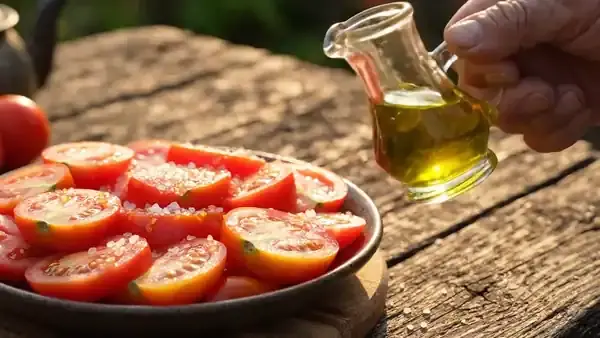
In the middle of all of it sits the same small glass cruet of olive oil.
My wife bought it at an estate sale thirty years ago, and it hasn't missed a supper since.
This year my brother-in-law Leon set something down right beside it.
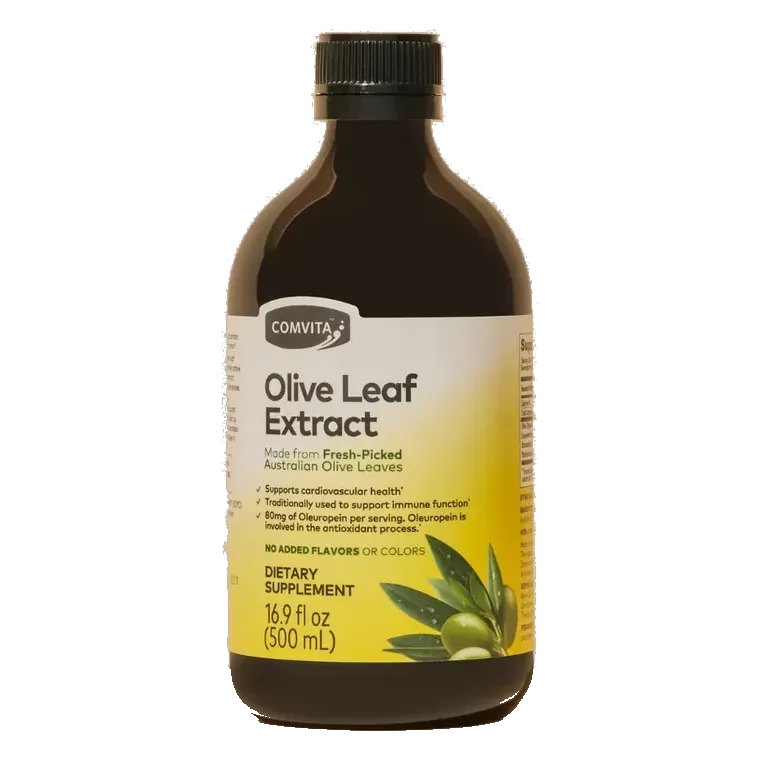
A dark bottle with a yellow label, a little shorter than a wine bottle, with a sprig of olive leaves printed on the front.
"Olive leaf extract," he said, and tapped the cap.
"A tablespoon a day, same tree as your oil. So is it the same thing, in a spoon?"
Nobody at the table knew.
My sister guessed yes, the fellow from next door guessed no, and my wife asked who wanted more beans.
Same tree, different part. That turned out to be most of the answer.
So I took the bottle home, the way I take home anything somebody sets on that table with a question attached.
I read the label, the seller's page, the return terms, and every study I could find with the leaf in its title.
This page is my reading of it, written out at the length it deserves.
It isn't a verdict, and it isn't medical advice.
It's one bottle, read by a man who has set a long table for forty years.
By the end you'll know what's in the tablespoon, what the studies measured, and where the oil on your own table fits in.
The oil comes from the fruit, the tablespoon comes from the leaf, and the two are not the same food.
Forty Septembers at the Long Table
The harvest supper started with my father, who farmed a little and gardened a lot.
He used to say a garden isn't finished until somebody eats it with people they like.

So once a year we set it out and ask everybody.
Neighbors, cousins, the fellow who plows our road in winter, and whoever they care to bring.
You probably have your own version of that table.
A church supper, a reunion at the lake, a Thanksgiving that always runs long, a Sunday dinner with your kids.
And you probably know how the talk drifts once the plates are full.
Somebody's knees, somebody's grandchild, the price of feed, and sooner or later, somebody's heart.
Not in a frightening way.
Men past sixty talk about the heart and circulation the way they talk about the roof: it's held up fine, and they'd like it to keep doing that.
The hill up from the creek is the same hill it always was.
It just seems to have gotten a little longer, and you'd like to keep climbing it for another twenty years.
So somebody walks every morning now.
Somebody switched from butter to olive oil after his last yearly visit, and mentions it every September.
Somebody else read that the Mediterranean way of eating is the one to copy.
And every year, the oil cruet in the middle of the table gets passed around a little more often.
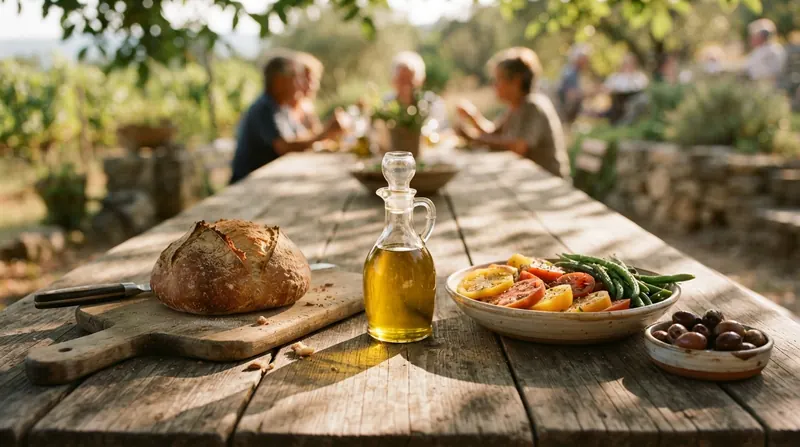
That cruet is where this story starts.
When Leon set his bottle beside it, he was asking a question a lot of us carry around without saying it out loud.
If the oil earned its place on the table, does the rest of the tree deserve one too?
It's a fair question, and it deserves a better answer than a guess over the beans.
Leon's Question, Asked Over the Bread
Leon isn't a man who buys things on a whim.
He spent thirty-one years as a county surveyor, and he still measures twice before he builds a birdhouse.
He'd read about olive leaf on his own, the way you read about anything these days.
A little from the seller, a little from a magazine at the barber's, a little from his daughter.
What had stuck with him was the tree.
Olives, olive oil, and those magazine photographs of old men on Greek islands, always at a long table in the sun.
And now here was the leaf of that same tree, in a bottle, measured by the tablespoon.
It made sense to him the way a lot of things make sense at first: same tree, same goodness, just more of it.
The trouble with "same tree" is that a tree has a lot of parts.
Think about an apple tree for a second.
Nobody believes a spoonful of apple bark is the same thing as an apple.
An olive tree works the same way.
The fruit is one thing, the oil pressed from the fruit is another, and the leaf is a third.
They share a trunk, but they don't share a label.
They're gathered at different times, used in different ways, and they end up in very different places.
So what does the oil on our table actually stand for?
Mostly, it stands for a way of eating, and that way of eating has been written down in numbers.
A 2015 review that set out to define the Mediterranean pattern described three to nine servings of vegetables a day, half to two servings of fruit, and one to thirteen servings of cereals. [1]
It allowed up to eight servings of olive oil a day, with about 37% of the day's energy from fat and about 33 grams of fiber. [1]
Read those numbers again, slowly.
The oil is a big part of the picture, but it rides on top of a mountain of vegetables, fruit, grain and fiber.
In other words, the oil is the dressing on a whole way of eating.
Pour more of it and you haven't eaten more Mediterranean. You've just eaten more oil.
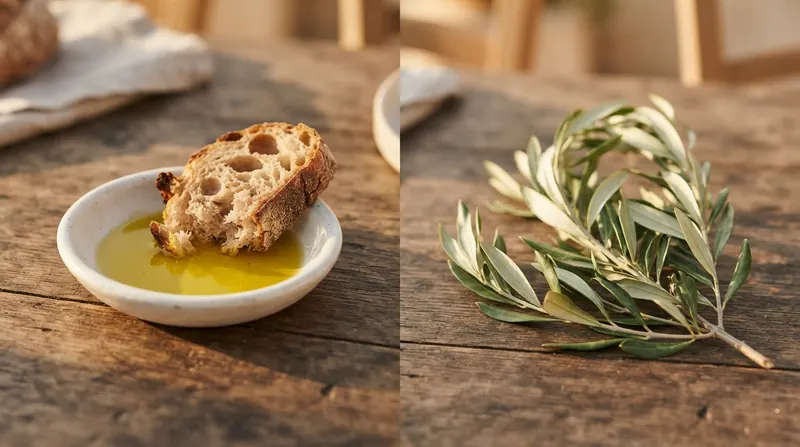
And a leaf extract isn't that pattern either. It isn't oil, and it isn't a meal.
That doesn't make the bottle useless, and it doesn't make it special.
It makes it a different question, and a different question needs its own answer.
Before I could answer it, I had to know the tree better than I did.
So that's where we'll go next: out to the grove, where the three parts part ways.
One Tree, Three Harvests: the Fruit, the Oil and the Leaf
If you've never stood in an olive grove, here's the short version.
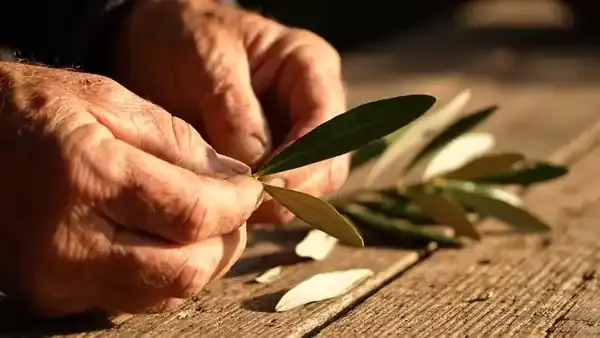
The trees are gnarled and grey, and the leaves are narrow, dark green on top and silver underneath.
When the wind comes through, the whole grove seems to flicker.
That's the leaves turning over, thousands at a time, and it's the first thing anybody remembers about the place.
The fruit comes in the fall.
Picked green or left on the branch to darken, it's too bitter to eat straight off the tree, which is why olives go into brine before they ever reach a table.
The oil comes from pressing that fruit.
It's the part of the tree that has traveled farthest, into nearly every kitchen in the country and onto our table under the walnut.
And the leaf?
The leaf mostly stays on the tree, until the pruning saws come out.
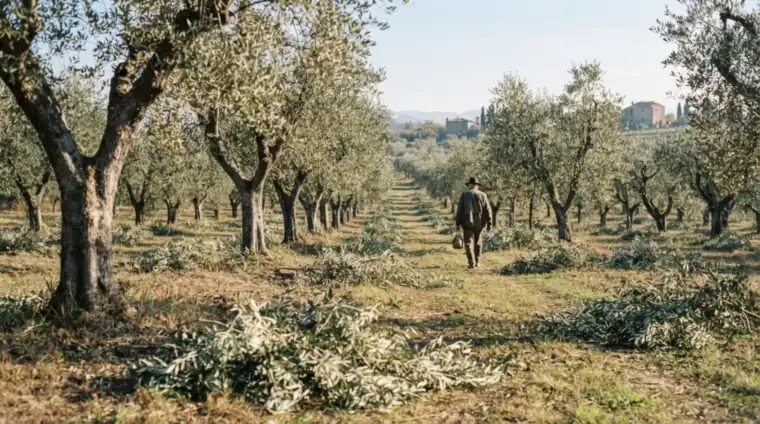
Growers prune olive trees to keep them open to the light and easy to pick.
Every winter and spring, cut branches heavy with leaves come down between the rows.
Around the Mediterranean, the leaves have long been brewed as a tea.
The European Union's herbal monograph on olive leaf lists that use, as a decoction of fresh or dried leaves in water. [2]
What's in the leaf, then?
Its most abundant plant compound is called oleuropein, a polyphenol the tree makes in quantity. [3]
Oleuropein is bitter.
It's a big part of the reason a raw olive needs brine, and the reason nobody has ever tossed olive leaves into a salad.
In one study that collected leaves from six olive varieties at harvest, in winter dormancy and at pruning time, oleuropein was the most abundant phenolic compound. [3]
The levels moved with the variety, the season, the tree's nutrients and the weather. [3]
So a leaf picked in one grove in one month isn't the same as a leaf picked somewhere else in another.
Keep that in mind, because it matters a great deal once somebody puts the leaf in a bottle.
Leon listened to all of this with his arms folded, the way surveyors do.
Then he asked the right question: "Fine. But what's on my plate already?"
What the Plate Already Carries, Before Any Bottle
He was right to start there, and so should you.
Before anything goes into a tablespoon, it's worth knowing what's already on the table, and what the federal guidelines say belongs there.
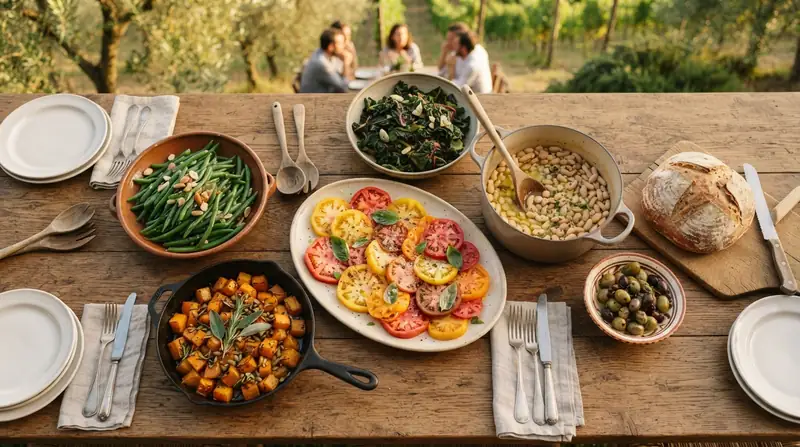
The Dietary Guidelines for Americans, 2025–2030, set a goal of three servings of vegetables and two of fruit a day, eaten whole. [4]
Frozen, dried or canned with little or no added sugar still counts. [4]
They name olive oil among the sources of healthy fat, alongside omega-3-rich seafood, nuts, seeds, olives and avocados. [4]
And they ask you to trade the deep fryer for baking, broiling, roasting, stir-frying or grilling. [4]
So the oil cruet is doing its job?
It's on the list, yes, as a fat to cook and dress with, and that's all the guidelines ask of it.
Now look at the other end of the table, where the salt sits.
The US Food and Drug Administration says Americans eat about 3,400 mg of sodium a day on average, against a limit of less than 2,300 mg, about one teaspoon of table salt. [5]
And the salt isn't mostly coming from the shaker.
Over 70% of it comes from packaged and prepared foods, led by deli-meat sandwiches, pizza, burritos and tacos, soups and savory snacks. [5]
That's why a harvest supper is easy on this count.
Almost nothing on that table came out of a box.
The shaker gets the blame. The deli counter does the work.
On a label, the rule of thumb is simple.
Five percent of the Daily Value or less per serving is low, and 20% or more is high. [5]
The guidelines apply that sodium limit to everyone 14 and older, not just to men our age. [6]
They also ask us to steer clear of highly processed foods that are salty or sweet, like chips, cookies and candy. [6]
What about the glasses?
The guidelines say to choose water, still or sparkling, and unsweetened drinks, and to avoid sodas, fruit drinks and energy drinks. [7]
They also keep fruit or vegetable juice to limited portions, or diluted with water. [7]
Remember that one, because the label on Leon's bottle suggests juice, and a small glass is all it needs.
On alcohol, the same guidelines are plain: drink less for better overall health. [7]
They add that people who take anything daily that can interact with it should avoid it entirely. [7]
There's one more thing on that plate that Leon hadn't thought about, and it's green.
Vegetables are where most of the nitrate in our diet comes from, about 80% of it. [8]
The body turns part of that nitrate into nitrite, with help from bacteria in the mouth. [8]
You'll hear nitrite and nitric oxide a lot in talk about healthy blood flow, so here's what one small trial actually measured.
In a 2009 analysis, two day-long menus built on the same vegetable-rich eating plan delivered anywhere from 174 mg to 1,222 mg of nitrate. [8]
The only difference was which vegetables and fruits went on the plate. [8]
And in a trial of 30 healthy men and women, a single meal with nitrate-rich spinach raised plasma nitrite and other markers of nitric oxide in the blood. [9]
It was followed by a greater widening of the arm artery on ultrasound than a comparison meal, and flavonoid-rich apples did something similar. [9]
One meal, thirty people, one measurement on an ultrasound screen.
It isn't a promise about your heart, but it's a real measurement, and it came from a plate, not a bottle.
The oldest nitric oxide food there is may be a bowl of greens, and it's already on the table.
The Walk After Supper, Counted Minute by Minute
When the plates are cleared, half the table goes for a walk down the lane.
It's become part of the supper, the way the pie has.

Does an evening walk like that count for anything?
It counts, and the federal guidelines say so in plain numbers.
The Physical Activity Guidelines for Americans set a weekly range of 150 to 300 minutes of moderate activity, such as brisk walking, spread through the week. [10]
They add muscle-strengthening activity on two or more days, and they say some activity is better than none. [10]
They also dropped an old rule you'd probably still hear at the barbershop.
Bouts of any length now count toward the weekly total, and even climbing a few flights of stairs counts. [11]
And 10,000 steps a day?
The guidelines call it popular advice, not a guideline. [11]
Their own worked example is humbler, and more useful.
Add a 20-minute walk, about 2,000 steps, to a usual day of about 5,000, and you're near 7,000. [11]
Twenty minutes down the lane is the government's own example. Leon liked that.
For those of us past sixty, the guidelines add balance work alongside the walking and the strengthening. [12]
And they ask older adults to set their effort by their own fitness, not by anybody else's. [12]
How brisk is brisk?
The CDC has a test you can take on any farm lane: at a moderate pace you can talk, but you can't sing. [13]
If you can only get out a few words before you need a breath, you've moved into vigorous. [13]
The CDC counts walking at 2.5 miles per hour or faster as moderate. [13]
In a laboratory study of 98 healthy adults aged 61 to 85, a pace of about 100 steps a minute marked the start of moderate intensity. [14]
That's roughly three times the energy you use sitting still, and 110 and 120 steps a minute came out at about four and five times. [14]

A review that turned these guidelines into step counts found that healthy older adults take anywhere from 2,000 to 9,000 steps a day. [15]
Thirty minutes of brisk activity on top of ordinary movement works out to roughly 7,000 to 10,000 steps. [15]
So when half the table walks down the lane after supper, it isn't a gesture.
It's a slice of the week that the guidelines actually count.
Leon walks it every year, with the pie still in him.
This year he walked it with a bottle's worth of questions, and I walked it with him.
Eight Things Worth Keeping, and Four of Them Live at the Clinic
There was one more stop before Leon's bottle, and my wife insisted on it.
"Tell him about the yearly visit," she said from the porch. "That's where the numbers are."
She had a point, as she usually does.
The American Heart Association keeps a scorecard called Life's Essential 8, and it scores eight things from 0 to 100. [16]
Four of the eight are daily habits, among them diet, physical activity and nicotine exposure. [16]
The other four are measurements of the body, and those are best checked with a clinician. [16]
Read that split one more time.
Half of the scorecard lives at your table and on your lane, and the other half lives at your clinician's office.

No spoon, no bottle and no harvest supper can take a measurement.
If it's been more than a year since your last visit, that appointment is worth more than anything else on this page.
Half the card is kept at home. The other half is kept by your clinician.
What about the nicotine line?
The CDC says quitting smoking has health benefits at any age, no matter how long or how much a person has smoked. [17]
It says quitting can add as much as 10 years to life expectancy. [17]
And within a few days of quitting, the carbon monoxide level in the blood drops to that of someone who doesn't smoke. [17]
Nobody at our table smokes anymore, but three of us used to, and two of them quit after sixty.
Neither one had anything to buy for it, and both still bring it up when the pie comes out.
So why write about a bottle at all?
Because Leon asked, and because a lot of men who already walk and already cook with oil are asking the same thing.
The Part of the Tree That Never Reaches the Table
By now you might be thinking what my wife said when I read all this out loud on the porch.
"So we already do the good part. Why is Leon's bottle still on my counter?"
It's the question every honest page about a supplement ought to have to answer.
Here's mine, as plainly as I can put it.
Your plate can carry the fruit of the olive tree, brined, and the oil of the olive tree, poured.
It can't carry the leaf, because nobody eats olive leaves; they're too tough and too bitter.
The leaf is the one part of that famous tree that never reaches the table.
If you want what's in it, you either brew it as a tea or you take it some other way.
That's the whole reason a bottle like Leon's exists.
It isn't a better olive oil, and it isn't a way around the vegetables or the walk.
It's the leaf, brought to the table in the one form a table will take it: a spoon.
Whether that's worth doing is the rest of this page.
But first, here's exactly what was in the bottle he set beside our cruet.
That's the bottle, as the seller photographs it.
It's called Olive Leaf Extract, it's sold by Comvita USA, Inc., and most of what the company sells is manuka honey.
The leaf in this bottle comes from Australia, though.
The label says it's made from freshly picked leaves grown at the company's own olive grove, and extracted fresh on its farm in Queensland.
The maker's address on the label is on Bischoffs Road in Coominya, a small Queensland town west of Brisbane.
The company says it has grown, harvested and made olive leaf products there for over 20 years.
What's on the front, in plain words?
"Olive Leaf Extract," "Made from Fresh-Picked Australian Olive Leaves," "Dietary Supplement," and 16.9 fl oz, which is 500 mL.
It also says "No added flavors or colors," and "80mg of Oleuropein per serving."
Right after that comes one line about what the compound does: "Oleuropein is involved in the antioxidant process."*
That's a modest sentence, and I'll take it at face value.
It describes chemistry in the leaf, not a result you'd feel, and the label cites no study for it.
Seven Questions I Put to the Label
I read labels the way Leon reads a property line.
Slowly, from one corner to the other, and out loud when something doesn't add up.
Question one: how much do I take?
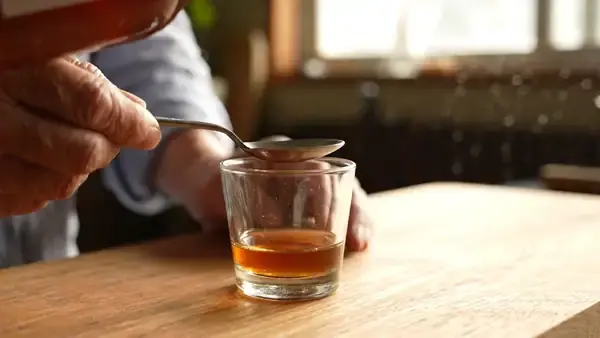
One tablespoon, which is 15 mL, once a day, by the label.
The label says it can be taken straight or diluted with juice, and not to go past the recommended daily amount.
The seller's page adds water, tea or a smoothie as other ways to take it.
Question two: what's actually in the tablespoon?
Two things, about half and half: 7.5 mL of olive leaf extract, and vegetable glycerin for the rest.
The extract is what the label is about.
The glycerin is the base: a clear, sweet, syrupy liquid made from plant oils that carries the extract and keeps the bottle from spoiling.
Question three: what does "equivalent to 12 g of fresh leaf" mean?
It means the 7.5 mL of extract in your spoon corresponds, by the maker's own figure, to about 12 grams of fresh olive leaf.
Twelve grams of fresh leaf is about a loose handful off a pruned branch.
It isn't something you'd want to chew, which is the whole point of making an extract.
Question four: why does it say "standardized"?
Because, as you read out in the grove, the amount of oleuropein in olive leaves moves with the variety, the season and the weather. [3]
The label says the company uses a special process to standardize the levels of two compounds, oleuropein and hydroxytyrosol.
That's how it can print a fixed number on every tablespoon: 80 mg of the first and 750 mcg of the second.
Question five: what's hydroxytyrosol?
It's what the body makes when it breaks oleuropein down, and the bottle carries a little of it ready-made.
Seven hundred fifty micrograms is less than one milligram.
Next to the 80 mg of oleuropein, it's about a hundredth as much.
Question six: is there alcohol in it?
No, and the label says so outright: "Does not contain alcohol."
That matters more than you might think.
A lot of herbal liquids are made in alcohol, and if you've given up the evening glass or never had one, this one fits.
Question seven: what else does the panel say?
Each tablespoon has 40 calories and 10 grams of carbohydrate, 4% of the Daily Value, and they come from the glycerin.
The label says no added sugar, no yeast, no artificial colors, flavors or preservatives, and no gluten.
It asks you to keep the bottle below 86°F, which in our house means the pantry, not the shelf over the stove.
Half a tablespoon of leaf extract, half a tablespoon of sweet glycerin, and nothing else on the panel.
Twelve Grams of Leaf, Next to the Old European Cup
Now for the comparison Leon cared about most.
If people around the Mediterranean brewed the leaf as tea, how does one tablespoon stack up against one cup?
The best yardstick is the European Union's herbal monograph on olive leaf.
It accepts olive leaf only on the basis of traditional use, which means long use in kitchens and households rather than proof from trials. [2]
For adults, it lists a decoction of 10 grams of fresh leaves, or 5 grams of dried, in 150 ml of water, twice a day. [2]
It also lists an infusion of 6 to 10 grams of dried leaf, up to three times a day. [2]
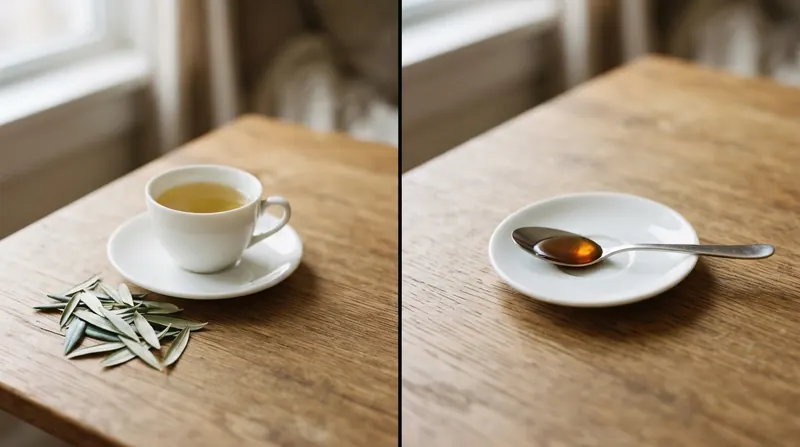
So, on paper, one tablespoon of this bottle corresponds to about 12 grams of fresh leaf.
One cup of the monograph's decoction starts from 10 grams of fresh leaf, and the monograph has you drink two a day.
That puts one tablespoon a little above one cup, and a little over half of a full day of the old tea, fresh leaf for fresh leaf.
It's the kind of arithmetic Leon enjoys, and it's honest as far as it goes.
How far does it go?
Not all the way, because a decoction and a glycerin extract aren't the same preparation.
The monograph describes leaf brewed in water, not a liquid extract like this one.
So the comparison is fair for the amount of leaf that went in, and silent about what comes out.
The monograph has a few other lines worth reading.
It doesn't recommend olive leaf for anyone under 18, and it advises against it for anyone who has been told to drink less fluid than usual. [2]
And the committee noted studies in which olive leaf increased the daily volume of urine. [2]
If you've been told to watch how much you drink, this is a bottle to ask about first.
None of that is alarming.
It's the plain, practical fine print that tells you a document was written by people who wanted it read.
A tablespoon a day sits near the old cup on paper, and the old cup was only ever judged by tradition.
From the Spoon to the Blood, and Out Again
Leon's next question was the one every skeptic asks.
"Fine, it's leaf in a spoon. But does any of it get anywhere?"
That one, at least, has been measured.
In a randomized crossover study, nine adults with an average age of about 43 took single doses of olive leaf extract, once as a liquid and once in capsules. [18]
The single doses in that study held 51 and 77 milligrams of oleuropein, below the 80 in one tablespoon here. [18]
Oleuropein reached higher peak levels in the blood after the liquid than after the capsules. [18]
The main hydroxytyrosol compounds peaked at similar levels either way, but sooner after the liquid: about 64 minutes, against 93. [18]
They showed up in the urine within 8 hours, with wide differences from one person to the next. [18]

So the liquid beats the capsule?
For how high the oleuropein peaked in the blood of nine people after one dose, yes.
That's all the study measured, though.
It tracked levels in blood and urine, not how anybody felt, walked or did anything else.
A second study followed what happens next.
In urine from 17 healthy volunteers who took an olive leaf extract, compared with their own samples from beforehand, the original compounds were scarcely detected. [19]
The body had transformed them extensively.
The researchers identified 176 related compounds, including 28 forms of oleuropein and 48 that came from its breakdown into hydroxytyrosol and elenolic acid. [19]
Most of it was excreted within the first 6 hours. [19]
In plain terms, the leaf's compounds get in, get changed, and mostly leave the same day.
In, changed, and mostly gone by suppertime. That's the whole story the blood and urine tell.
If you take it, that's the rhythm to expect.
A tablespoon in, mostly cleared the same day, and another one tomorrow, the way the label lays it out.
It's the same rhythm as the walk down the lane.
Nothing about it adds up in a single evening; whatever it does, it would do one ordinary day at a time.
Thirty-Six Days, Forty Men Around Sixty
Getting into the blood is one thing.
Doing something you could notice is another, and for that, one trial comes closest to a man at our table.
It was a 36-day randomized, double-blind trial against a placebo, in 40 healthy men with an average age of about 60. [20]
They took either 100 mg of oleuropein a day, from 250 mg of olive leaf extract, or a placebo. [20]
The oleuropein compounds in their blood went up, as you'd expect by now. [20]
And there was one more finding, deep inside the muscle.
A muscle enzyme that feeds fuel into cellular energy production at rest was more active: about 49% of it in its active form, against 38%. [20]
Its name is pyruvate dehydrogenase, and you'll never need to remember it. [20]
So did the men get stronger, or tire less?
No, and the researchers reported it plainly.
The trial found no change in the muscles' mitochondrial respiration, in leg strength, in how quickly the legs tired, or in whole-body energy use. [20]
A marker moved inside the muscle; the legs themselves didn't notice.

I like this trial, and I like it because it's honest about what it didn't find.
It tested men our age, it ran more than a month, and it measured the things you'd actually care about.
It also used capsules, not a liquid, and 100 mg a day rather than the 80 in one tablespoon here. [20]
So even the closest trial is a neighbor of this bottle, not the bottle itself.
Something moved inside the muscle. The hill stayed the same hill.
Is there a trial of this exact bottle?
Not one that I could find, and the seller's page doesn't cite one.
What's Actually in the Bottle, and How Anyone Knows
A label is a promise printed in small type.
The fair question is whether anybody has checked it.
For olive leaf, somebody has, at least in one country.
A laboratory analysis of ten olive leaf extract products sold in Australia found that their oleuropein and hydroxytyrosol varied substantially from one product to the next. [21]
Two of those ten were from Comvita.
And every product that printed an amount for these compounds met or exceeded it. [21]
The same analysis saw a trend worth knowing about.
Products made from fresh leaves tended to carry more oleuropein and less hydroxytyrosol than products made from dried leaves. [21]
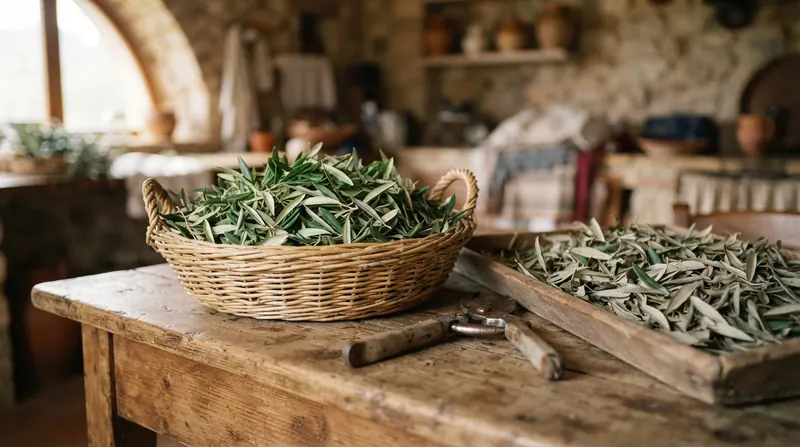
That's a point in favor of what this label says about fresh-picked leaves.
But be careful with it: those were products sold in Australia in 2019 and 2020, not the American bottle Leon set on our table.
Why does fresh versus dried matter at all?
Because the leaf is a living thing, and its chemistry moves with the variety, the season, the tree's nutrients and the weather. [3]

That's why "standardized" is the most useful word on the label.
It tells you the maker is aiming at a fixed number, rather than bottling whatever the grove happened to give that month.
Has anyone checked that large amounts are harmless?
In laboratory and animal tests of a different, water-soluble olive leaf extract, there was no sign of genetic damage in bacterial, cell and mouse tests. [22]
Rats given up to 1,000 mg per kilogram of body weight a day for 90 days showed no deaths or toxic effects. [22]
That's reassuring as far as it goes, and it doesn't go all the way: it was another company's extract, tested in animals, not people.
So here's where the contents stand.
The label's numbers are specific, the maker's Australian liquids met their labels in one lab analysis, and nobody has published an analysis of this particular American bottle.
The number on the label has matched a lab's number once, for this maker, in another country.
Leon wrote that down, the way he writes down a benchmark.
"Once is better than never," he said, "but it isn't a survey."
The Bitter Leaf and the Sweet Base, in One Spoon
Let's talk about taste, because taste decides more than any study whether a bottle gets finished.
Oleuropein is bitter, and a leaf full of it will never taste like a salad.
The glycerin is the other half of the story.
It's sweet and syrupy by nature, and it sits in the same spoon as the leaf, with no flavoring added to either one.
So what does the spoon taste like?
How those two balance is a matter of your own tongue, and the seller's reviews are a better guide than my guess.
One buyer who has reviewed the bottle twice, a year apart, put it in thirteen words.
"Very tasty on its own but also mixes well in drinks or foods."
If you're the kind of man who takes his coffee black and his grapefruit without sugar, you'll probably take it straight.
If not, the label and the seller give you a few other ways in.
- Straight from the tablespoon, the way the label puts it first.
- Stirred into a small glass of juice, which the label names.
- Diluted in a glass of water, as the seller suggests.
- Stirred into a cup of tea, the seller's other idea for a cold morning.
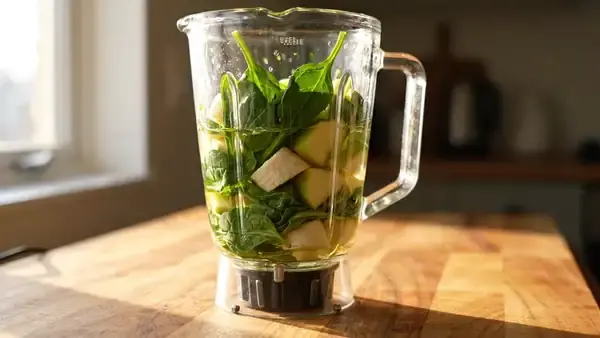
- Blended into a morning smoothie, the seller's third.
Does mixing it change anything?
Not on the label, which gives the same tablespoon whichever way you take it.
It does change the arithmetic of the glass, though.
A tall tumbler of juice every morning adds up, and the guidelines keep juice to limited portions, or diluted with water. [7]
So if juice is how you take it, make it a small glass, or half juice and half water.
The tablespoon doesn't need a big ride.
And if the spinach smoothie is your vehicle, you're getting a little of that nitrate from the greens along the way. [8]
That's the plate doing its job again, with the leaf riding along.

My wife's view, for the record, was practical.
"If it tastes like something you'd make a face at, it'll sit in the pantry until next September."
She's right about that, and it's the best reason to try one bottle before you commit to anything more.
We'll come back to it when we get to returns, because it matters there too.
An Ordinary Day With One Tablespoon in It
Let me walk you through what a day with this bottle would look like, at our place or yours.
Nothing about it should feel like a project.
Morning. Coffee first, the way it's always been, and a 20-minute walk down the lane while the grass is still wet.
That's the guidelines' own example, counted before breakfast. [11]

Breakfast. A small glass of juice with the tablespoon stirred in, or the tablespoon straight and a glass of water after.
Eggs, toast, and a sliced tomato while the garden's still giving.
Midday. Nothing to take, nothing to remember.
The bottle goes back in the pantry, away from the stove, below the 86°F the label asks for.
Supper. The oil cruet on the table, beans or greens, fish if somebody went to the market, and bread you share.
Then, if the light's still good, the lane again.
That's it.
The only new thing in that whole day is one tablespoon, and everything around it is the plate and the walk that were already there.
One spoon in the morning. Everything else stays the way the table always had it.
How long does a bottle last?
About 33 tablespoons, so a little over a month at one a day.
When would you know if it suits you?
You'll know about the taste on the first morning, and about the habit in a couple of weeks.
As for anything more than that, be honest with yourself about what the research measured.
It measured compounds in the blood and a marker in the muscle, not a feeling you'd write home about.
If that summary sounds modest, good.
Modest is the honest size of this bottle, and it's a size a lot of men would still be glad to try.
Who This Bottle Suits, and Who Should Ask First
Not everybody at our table should have Leon's bottle in the pantry.
Here's how I'd sort it, from the label, the monograph and plain common sense.
It suits a man who already does the easy things and is curious about the leaf.
He walks, he cooks with oil, he eats his greens, and he'd like to try the part of the tree his plate can't carry.
It suits a man who won't swallow capsules.
A tablespoon is easier for a lot of us than one more thing to wash down with water.
It suits a man who keeps alcohol out of everything, even small amounts.
The label is clear that there's none in it.
It doesn't suit anyone under 18.
The European monograph doesn't recommend olive leaf below that age. [2]
Ask first if you take anything daily.
If you take anything daily, and especially anything for your glucose, show this label to your pharmacist before the first tablespoon.
Ask first if you're pregnant or nursing.
The label asks you to consult a healthcare practitioner before use, so ask your own clinician.
Ask first if you've been told to drink less fluid than usual.
The monograph advises against olive leaf in that situation, and it notes studies with a larger daily volume of urine. [2]
Count it if you count carbohydrates.
Ten grams per tablespoon is small, but it isn't nothing, and all of it comes from the glycerin.
If any of those "ask first" lines is you, the pharmacist's counter costs you nothing but a few minutes.
The Fair Objections, Heard Out at the Table
Leon heard everything above and still had objections.
Good. So should you.
"It's not cheap for a bottle of leaves."
The price is on the seller's page, and it moves with promotions, so I won't print a number that could be wrong by the time you read this.
Here's the fairer way to judge it.
Divide the price by 33 tablespoons, and put that daily number next to a cup of good tea or a bunch of greens.
"It's bitter."
It might be, to you, and there's no way to know except the first spoon.
That's exactly why I'd buy one bottle before any subscription.
As you'll see in a minute, an opened bottle can't go back.
"The evidence is thin."
It is, and this page has said so at every step: small studies, measured in blood, urine and muscle, never on this exact bottle.
What's there is honest, and one part of it fits a daily liquid: the oleuropein peak was higher from a liquid than from capsules. [18]
What isn't there is any trial showing you'd feel different on the lane.
"Why not just brew olive leaf tea?"
You can, and the European monograph describes exactly that. [2]
The bottle is for people who want a fixed, standardized number and one spoon instead of a pot brewed twice a day.
Both are fair ways to meet the leaf; neither one replaces the plate.
"I already use plenty of olive oil."
Good, keep using it, and remember that the oil and the leaf are different parts of the tree.
One doesn't substitute for the other in either direction.
The oil is food, and the tablespoon is a supplement.
"Where does it ship?"
Within the United States, from the seller's warehouse in Southern California by UPS, in about 3 to 10 business days.
It doesn't ship to Puerto Rico, the US Virgin Islands or Canada.
The listing says shipping is at no charge on orders of $75 or more.
No Satisfaction Promise, and I'd Rather Say So
Some sellers put a big refund promise next to the buy button.
This one doesn't, and I'd rather you hear it from me than find out after the bottle's open.
Here are the seller's return terms, as it writes them.
You contact its Customer Experience Team at hello@comvita.com within 7 days of receiving your order.
The bottle has to be unopened, as it arrived, and sent back with the packing slip.
You pay the shipping back, and the refund comes "minus a 20% restocking fee" to your original payment method.
So there's no trying it for a month and sending it back.
Once the seal is broken, the bottle is yours.
One bottle, one honest try of the taste, and no subscription until you know.
If you have questions before you order, the seller publishes a phone number, (855) 449-2201, answered weekdays from 9:00 to 4:30 Pacific time.
The email for customer questions is hello@comvita.com.
Five Reviews From the Seller's Page
The seller's page shows six reviews, all five stars, and every one carries the review system's mark for a confirmed purchase.
I left one out because it's about readings that belong with a clinician, not on this page.
The other five are below, word for word, including one woman who wrote twice, a year apart.
The small portraits are illustrations, not the reviewers themselves.


I've been taking OLE for a very long time and I feel this is the best that I have come across. Being liquid is usually the best way to absorb things.

Best place to buy liquid olive leaf extract. No 1

Too early to tell but the product seems very high grade. Glad I'm adding it to my supplements.
Very tasty on its own but also mixes well in drinks or foods.

Good for health
What do I take from them?
Thomas H. wrote the most useful one: "Too early to tell."
That's the right attitude for a daily tablespoon, and it's the one this page has tried to keep.
Jeanette M. writes that she has taken OLE, short for olive leaf extract, for a very long time, and that being liquid is usually the best way to absorb things.
On that last point, the nine-person study agrees as far as it went: the oleuropein peak was higher after the liquid than after capsules. [18]
Her second review, a year later, is about the taste, and it's the one I'd read before buying.
Five buyers and six reviews is a small sample, and reviews are opinions, not evidence.
But none of them promises you anything, and I trust them more for it.
What Costs Nothing at the Harvest Table
Before the bottle itself, here's the list I'd tape inside the pantry door, next to it or instead of it.
None of it costs a dime, and every line has a source.
- Walk 150 to 300 minutes a week at a brisk pace, spread through the week, and add muscle-strengthening activity on two days. [10]
- Count every bout; a 20-minute walk after supper is the guidelines' own example. [11]
- Walk fast enough that you can talk but not sing. [13]
- Keep sodium under 2,300 mg a day, and read the Daily Value line on the label. [5] [6]
- Put three servings of vegetables and two of fruit on the table every day. [4]
- Choose water and unsweetened drinks, and keep the juice glass small. [7]
- Cook with olive oil, and bake, roast or grill instead of frying. [4]
- If you smoke, stopping helps at any age, however long you've smoked. [17]
- Keep the yearly visit: four of the eight things on the heart scorecard are measurements best checked with a clinician. [16]
That list is the real harvest supper.
The tablespoon, if you choose it, is one small thing you add on top.
The Short Version, Before the Plates Are Cleared
- The oil comes from the fruit; the tablespoon comes from the leaf, the one part of the tree a plate never carries.
- One tablespoon holds 7.5 mL of extract, equivalent to 12 g of fresh leaf, with 80 mg of oleuropein, in sweet glycerin, with no alcohol.
- On paper that's a little above one cup of the old European leaf tea, which Europe accepts on tradition alone. [2]
- The leaf's compounds reach the blood, higher from a liquid than from capsules, and mostly leave the same day. [18] [19]
- In 40 healthy men around sixty, 100 mg a day moved a muscle marker, and strength and tiredness didn't change. [20]
- Nobody has tested this bottle; one lab found the maker's Australian liquids met their labels. [21]
- There's no satisfaction promise: returns only unopened, within 7 days, minus a 20% restocking fee.
- If you take anything daily, especially for your glucose, show the label to your pharmacist first.
The leaf of the olive tree, one tablespoon a day from a Queensland grove
A tablespoon a day of liquid extract from fresh-picked olive leaves grown on Comvita's own Queensland farm, standardized to 80 mg of oleuropein, taken straight or stirred into juice.
CHECK AVAILABILITYSold by Comvita USA, Inc., Santa Barbara, California · made in Coominya, Queensland, Australia · 500 mL, about 33 tablespoons, no alcohol · returns only unopened, within 7 days of delivery, minus a 20% restocking fee
Questions from the long table
Is this olive oil?
No. It's a liquid extract of the olive tree's leaves in vegetable glycerin.
How much do I take?
One tablespoon, 15 mL, once a day, by the label.
Straight or mixed?
Either. The label says straight or diluted with juice, and the seller adds water, tea or a smoothie.
Is there alcohol in it?
No. The label prints "Does not contain alcohol."
What does it taste like?
A bitter leaf in a sweet glycerin base, with no flavor added. One reviewer calls it "very tasty on its own."
How long does one bottle last?
About 33 tablespoons, a little over a month at one a day.
Does it have calories?
Forty per tablespoon, with 10 grams of carbohydrate from the glycerin and no added sugar.
I take something every day. Is that a problem?
Show the label to your pharmacist before the first tablespoon, especially if what you take is for your glucose.
Is it for teenagers?
No. The European monograph doesn't recommend olive leaf under 18. [2]
Where does it ship?
Within the United States from Southern California, but not to Puerto Rico, the US Virgin Islands or Canada.
Can I send it back?
Only unopened, within 7 days of receiving it, and the seller keeps a 20% restocking fee.
Has this exact bottle been studied?
No. The studies here used other olive leaf products; one lab analysis included two Comvita liquids sold in Australia. [21]
The Last Light on the Long Table
We carried the table back into the barn a little after nine, with the same fellow still lifting the wrong end.
Leon's bottle went home with Leon.
Before he left, he asked me for the short answer, the one he could give his daughter.
So I gave him the one I've given you.
The oil on the table comes from the olive, and it belongs there with the vegetables, the beans and the bread.
The tablespoon comes from the leaf, the part of the tree that never made it to the table until somebody put it in a bottle.

What the leaf has behind it is a long tradition as a tea, a compound that reaches the blood, and one honest trial in men our age that found a marker and not a stronger leg.
What it doesn't have is a promise, and the seller doesn't offer one either.
If that's enough to make you curious, one bottle and one honest month will tell you more about the taste and the habit than anything I can write.
If it isn't, keep the cruet, keep the greens, and keep walking the lane after supper.
Either way, the table stays the same. That was always the best part of it.
Sold and shipped by Comvita USA, Inc. within the United States. The price and any promotion are set by the seller.
The label, line by line, with the amount in each tablespoon, what each ingredient is, and what the cited research does and does not say about olive leaf, is written out in the ingredient and advertising guide linked at the foot of this page.
The guide also covers the glycerin base, the European monograph's cautions and the question worth taking to your pharmacist.